
From blessing to curse: BI-dashboard that nearly lost a multi-million Euro government tender
Our client was in its phase from start-up to scale-up, looking to gain market share by competing in strictly regulated EU-tenders. Our client provides software solutions for Electric Vehicles (EV’s).
It prides itself with a competitive advantage in the shape of a Business Intelligence (BI)-dashboard. It was the only provider with a functional BI-solution in place as part of its solution at the time of the tender. The tender concerned itself with servicing EV charging within a geography of the Dutch market. The contract is for a decade and took place in a newly-evolving market, resulting in a multitude of challenges.
Prefer to read this Insight offline?
We explored their challenge
Our client provided us with access to their Product Owners, Data Engineers and Data Scientists. These people all had direct involvement in developing the BI-dashboard. The Product Owners had content knowledge of the tender requirements. We also managed to have a dialogue with the government officials that made up the tender evaluation panel.
During these conversations we discovered key insights not captured in the tender requirements:
- BI-dashboard was developed in isolation by the Data Scientists and had not yet been exposed to end-user validation.
- Tender evaluation panel in charge of awarding the tender contract had limited statistical knowledge.
- Client organisation had minimal tender experience and faced steep competition from competing start-up to scale-ups.
We provided structure
We carefully studied the available tender requirements. During conversations with stakeholders we established that there were hidden requirements not explicitly documented. We had to ensure that stakeholders were on the same page:
- DevOps team
They maintained the BI-dashboard and had limited experience with tenders. We provided them with Epics, Features and User Stories that contained both explicit tender requirements as well as tender requirements we discovered during conversations. In doing so, the DevOps team was supported in their way of work that was common to them.
- Product Owners
Product Owners as a team supported the solution competing in the tender. They had to be provided with analytical insight that showed there was a clear difference between the tender documentation and the actual expectations of the tender evaluation panel. Key here is Product Owners realising they need to provide more functionality and business value within the same timeframe with the same resources. Achieving constructive collaboration is critical.
- Tender evaluation panel
After we discovered that their statistical knowledge was limited, the question of what was required to ensure understanding was achieved had to be made clear. The government officials noted that they were accustomed to supporting documentation that explains what they are looking at and how one should interpret that is displayed.
With the above stakeholders and input we were able to provide a structured approach to support our client.
Why structure matters
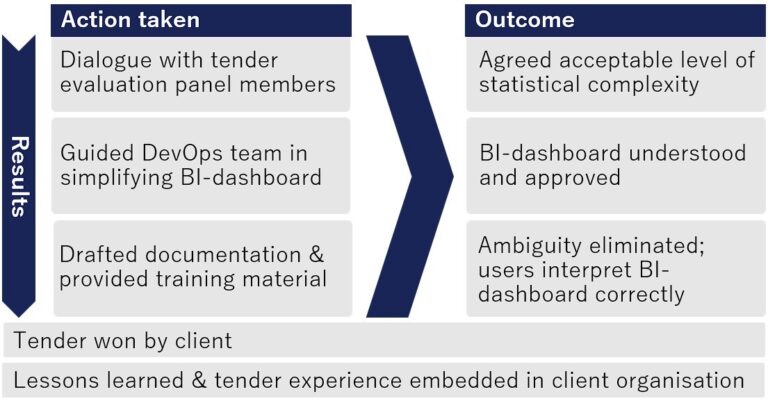
Not succeeding in aligning one of the above three key stakeholders would result in failure. The diagram below highlights the key actions taken and the resulting outcome. Structure matters because it secured the results as depicted.
We own the analysis; client owns a winning tender
Our structured approach ensured that the government officials that made up the tender evaluation panel were provided with guidance on how to operate the BI-dashboard. Our Business Analysis expertise combined seamlessly with the Data Science expertise our client had in-house to present a tender-awarding, winning combination.
The key takeaways we shared with our client after the tender was awarded to them can be listed as:
- Tailored communication is key
The Data Scientists were unable to convey the business value of the BI-dashboard to tender evaulation panel members. Not being aware of the limited statistical knowledge of their end-users nearly resulted in our client losing the tender. Tailoring communication to the world of experience of your users had proven useful.
- Empathic collaboration matters
Talking to the tender evaluation panel members revealed requirements on granularity of documentation as well as the acceptable level of complexity of statistical artefacts. These requirements would not have been revealed if Business Analysis only limited itself to desk research only.
- Business Analysis can make or break a tender
Our client had a competitive advantage with their BI-dashboard, but it was Business Analysis that was the glue that secured the tender.